
An ode to accidental intelligence
Karl Duncker’s candle problem. It sounds like the story of a man who keeps wasting his wages in Jo Malone. His young family waiting patiently for him to bring home something to eat, only for him to return with yet another expensive jar of violet leaf and bergamot.
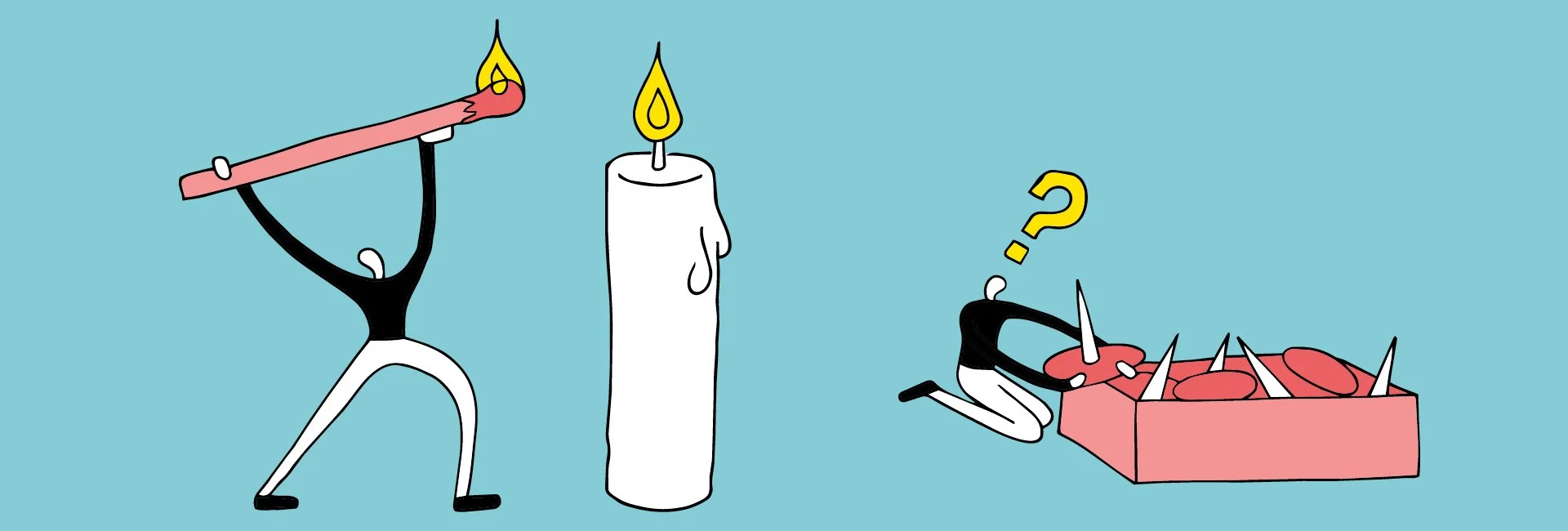
It’s not that though. It’s a cognitive experiment from 1945.
In it, participants are given a box of thumbtacks, a book of matches, and a candle. They have to attach the candle to the wall, in such a way that the wax won’t drip onto the floor below.
The solution is simple. Empty out the thumbtacks and use the box as a little tray for the candle to sit on – it catches the wax and it’s easy to tack to the wall.
Most people struggled. Their problem was a concept called ‘functional fixedness’. It’s a bias where we can’t see beyond an item’s established use. We see the box only as a container for the tacks, nothing else.
Incredibly, when presented with the box pre-emptied, sat beside the tacks, people were twice as likely to figure it out. Similarly, if it was introduced as a ‘box and tacks’ rather than a ‘box of tacks’, more people got it right.
I think a lot of creative breakthroughs come from using things in unexpected ways like this.
A lot of business breakthroughs do too.
Did you know bubblewrap was originally marketed as textured wallpaper? And Viagra was originally developed to lower blood pressure, until the side effects made themselves awkwardly clear during clinical trials? Or that frisbees started when some students found a second use for empty Frisbie Pie Company tins? Just picture it, in an alternative universe we could all be heading to the beach to play Frey Bentos.
The great swamp of sameness where all of the world’s independent thoughts funnel through the same rusty meat-grinder, towards a dark grey sludge of predictability. Every step of the process goes exactly where it’s supposed to go. Every ingredient is used exactly as it was intended to be. Homo Sapiens, and their propensity for distraction, tangents, and accidental magic, have outgrown their use.

I don’t buy into this future.
Brands need our messy fingerprints to make them interesting. Brands need the unexpected, and the unexpected needs humans.
It’s extremely rare to find a billionaire you can relate to, but I did love this recent rant from Strauss Zelnick, the CEO of Grand Theft Auto’s parent company Take-Two Interactive:
“Data sets by their very nature are backward-looking, creativity by its very nature is forward looking… With AI anyone can make a video game? Anyone could make a video game last week. Anyone could make a video game 5 years ago. The technology’s readily available, it’s commoditised. You know how many mobile games get put out a year? Thousands. You know how many hits are made every year? Zero to five. You know who makes them? Thank you very much, we do… All hits are by their very nature, unexpected. Things that are data-driven in their entirety can’t be unexpected.”
So, if you won’t take it from me, take it from the billionaire boss of a private equity investment firm that owns one of the world’s most lucrative video game franchises: “nobody wants to buy a clone”.
Whatever you do, don’t let your brand get sucked into the slop.
Who The LR We?
StudioLR is the creative agency that believes in guts. We’ve been grabbing people’s insides and making them interesting since 2004.
